About the Author
Shalom amigos.
My name is Victor. I’m a historian, educator, and student of Kabbalah and Ladino. I graduated from the University of Texas at Austin and have worked since 2016 as an independent genealogist, specializing in judeoconverso family histories. My professional work began with helping people obtain Spanish and Portuguese citizenship through Sephardic ancestry, but over the years I have also been deeply moved by the magnetism and yearning for Judaism I’ve witnessed among many non-Jewish friends and clients.
In 2019, I began documenting my own exploration of Sefarad on Instagram, writing from the perspective of a family historian. At the time, I had no intention of converting to Judaism or relocating to another continent; my focus was purely cultural and historical on all things related to crypto-Judaism and Sephardic identity.
In 2020, I studied Ladino in the Hebrew alphabet under Professor David Bunis at the University of Washington. That same year I experienced a series of deeply transformative events that reshaped my life. Thanks to my background in Judaic studies, I was able to interpret these experiences through the lens of Kabbalistic teachings. In doing so, I came to understand, within my own life, the root of the yearning that so many others had shared with me, and I developed a deeper connection to the Hebrew alphabet, Rashi script, and Solitreo.
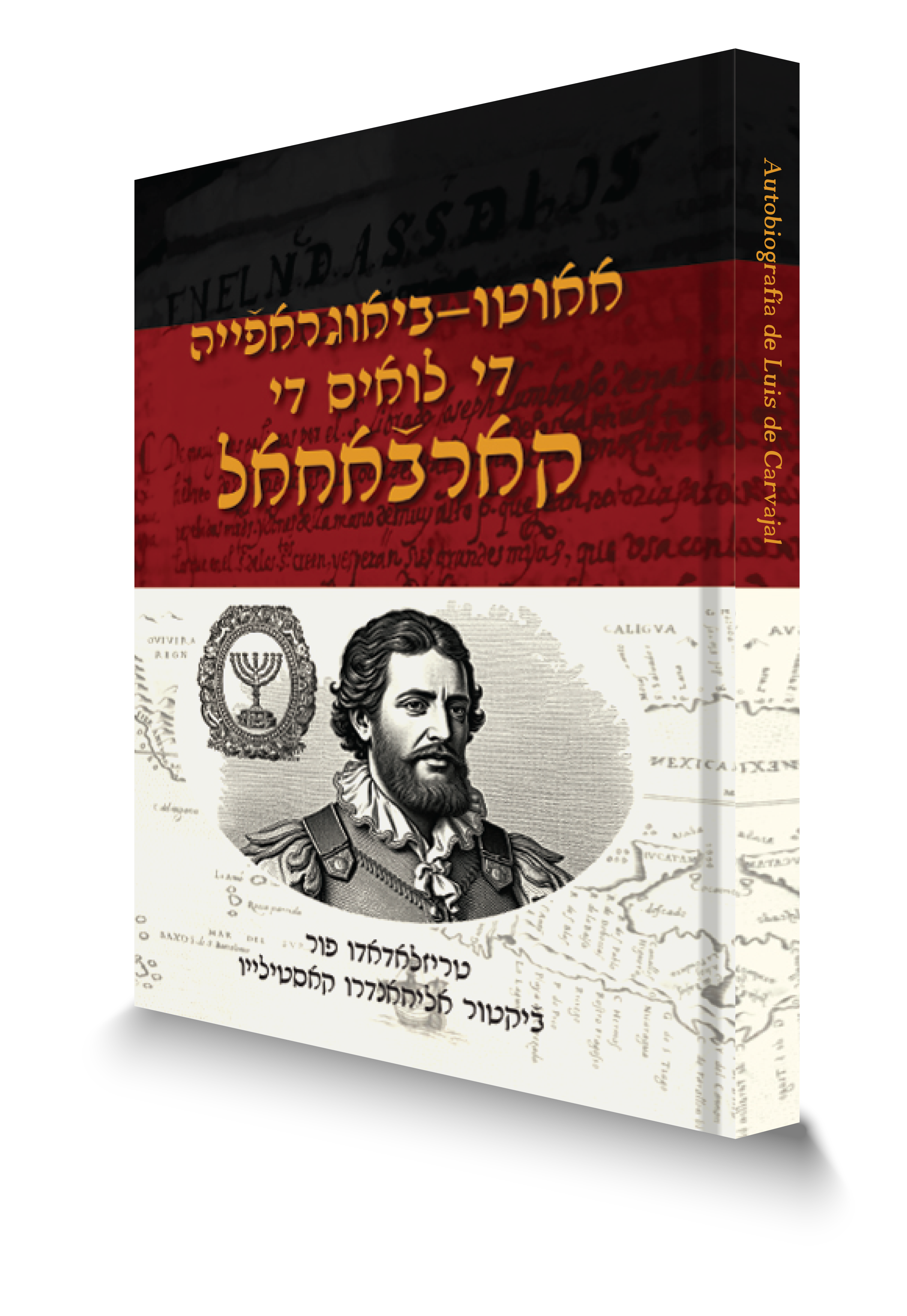
This book grows out of that journey. It’s written in Rashi script, the traditional Hebrew alphabet of Sephardic Jews, and it seeks to honor the legacy of Joseph Lumbroso, who longed to share his testimony of resilience and devotion to the one infinite Creator. My hope is that it will inspire others to continue their own search for meaning, fulfillment, and connection in this world and in the world to come.

Autobiography of Luis de Carvajal
The autobiography of Luis de Carvajal is the first known autobiography written by a Jew in the New World (1596). In these pages, Luis expresses his love for the God of Israel, his fidelity to the Law of Moses, and the path of suffering that led him to prison and martyrdom at the hands of the Inquisition in New Spain.
The manuscript was written in his own hand in sixteenth-century Spanish, with the style and sensibility of a Judeoconverso of Iberian origin. Lost for more than eighty years, the original text was considered gone until its miraculous rediscovery and return to the Archivo General de la Nación in Mexico in 2016.
This edition, which is intended to be published on the 10 year anniversary of the manuscript’s rediscovery, is presented in literary form and is written in the Rashi script, the traditional alphabet of Ladino spoken by the Sephardic Jews who were expelled from Spain in 1492 and settled in places such as Greece, Turkey, and the Balkans, and is written with traditional diacritics (nikud) to assist learners in reading and pronunciation.