
About the Book
A pedagogical tool
Judeo-Spanish, also known as Ladino, is the historical language of the Sephardic Jewish diaspora. It emerged after the expulsion of Jews from Spain in 1492, when Jewish communities carried a variety of 15th-century Iberian languages and dialects with them across the Mediterranean, the Ottoman Empire, and North Africa. Over centuries, the language preserved many features of medieval Ibero-Romance while absorbing elements from Hebrew, Turkish, Greek, and other surrounding languages. Traditionally, Ladino was written using Hebrew letters, most commonly the Rashi script, and often included Hebrew vowel marks (nikud) to guide pronunciation.
This book is designed as a bridge between that literary tradition and modern learners. The text has been translated from sixteenth-century Castilian Spanish into a contemporary form of Ladino, allowing readers to encounter the language in a way that is both historically grounded and accessible today. By presenting the text in traditional Rashi script with nikud diacritics, the book functions as a pedagogical tool for learning how to read Ladino in its classical written form.
On the Traditional Use of Diacritics
Between the 16th and 19th centuries, Ladino was written in a variety of ways and did not follow a single standardized orthographic system. Sephardic communities across the Ottoman Empire, North Africa, and Europe developed their own local conventions when writing the language in Hebrew letters. While many texts adapted Hebrew vowel marks (nikud) to clarify pronunciation for both vowels and consonants, the exact usage of these diacritics often varied from region to region and from one publication to another. Although several scholars and printers attempted to establish more consistent spelling conventions over time, a fully standardized system never took hold during this period.
In recent years, renewed efforts have been made to standardize the written form of Ladino. In 2019, the Autoridad Nasionala del Ladino introduced a comprehensive set of orthographic standards intended to support modern teaching and publication. Their system, however, chose not to incorporate the traditional Hebrew nikud. Instead, it relies primarily on Latin-style diacritic markers, most notably apostrophes, to represent pronunciation distinctions for specific consonant sounds, while maintaining a fluid approach for vowel pronunciation.
While this modern standard serves an important role in contemporary Ladino education, many historical Ladino texts continue to exist in their original form: written in Hebrew letters, frequently in Rashi script, and often using nikud to guide reading. For students interested in accessing this earlier body of literature, familiarity with these traditional diacritics remains essential.
This book therefore adopts a pedagogical approach that serves as a bridge between past and present. By presenting Ladino with traditional diacritics, readers can learn to recognize and interpret the conventions found in many surviving Sephardic texts. In doing so, the goal is not to replace modern standards, but to equip learners with the tools needed to engage directly with the historical written tradition of Ladino.
On the system used in this book
The diacritic system used in this book is based primarily on the conventions compiled by David M. Bunis in An Introduction to the Judezmo Language. Bunis’ work draws from a wide range of historical Ladino texts and provides a clear framework for understanding how Hebrew letters and nikud were traditionally used to represent the sounds of the language.
While no single orthographic standard existed historically, Bunis’ system reflects patterns that appear frequently across Sephardic publications. For this reason, it serves as a practical and historically informed guide for learners who wish to read Judeo-Spanish in its traditional script.
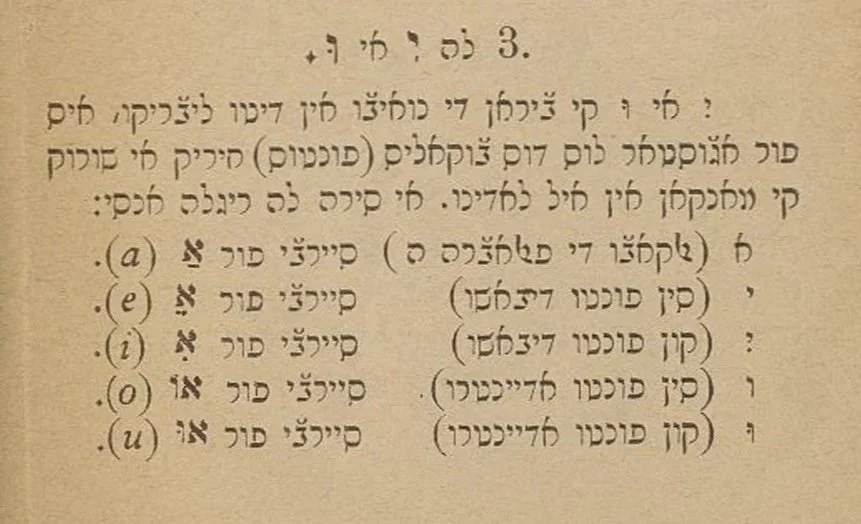
Proposed rules for vowel marks (hirik and shuruk) from Livro de Konverzasyon en Espanyol i Aleman, 1844

Proposed rules for consonant mark (rafe) from Silavaryo Espanyol, 1897
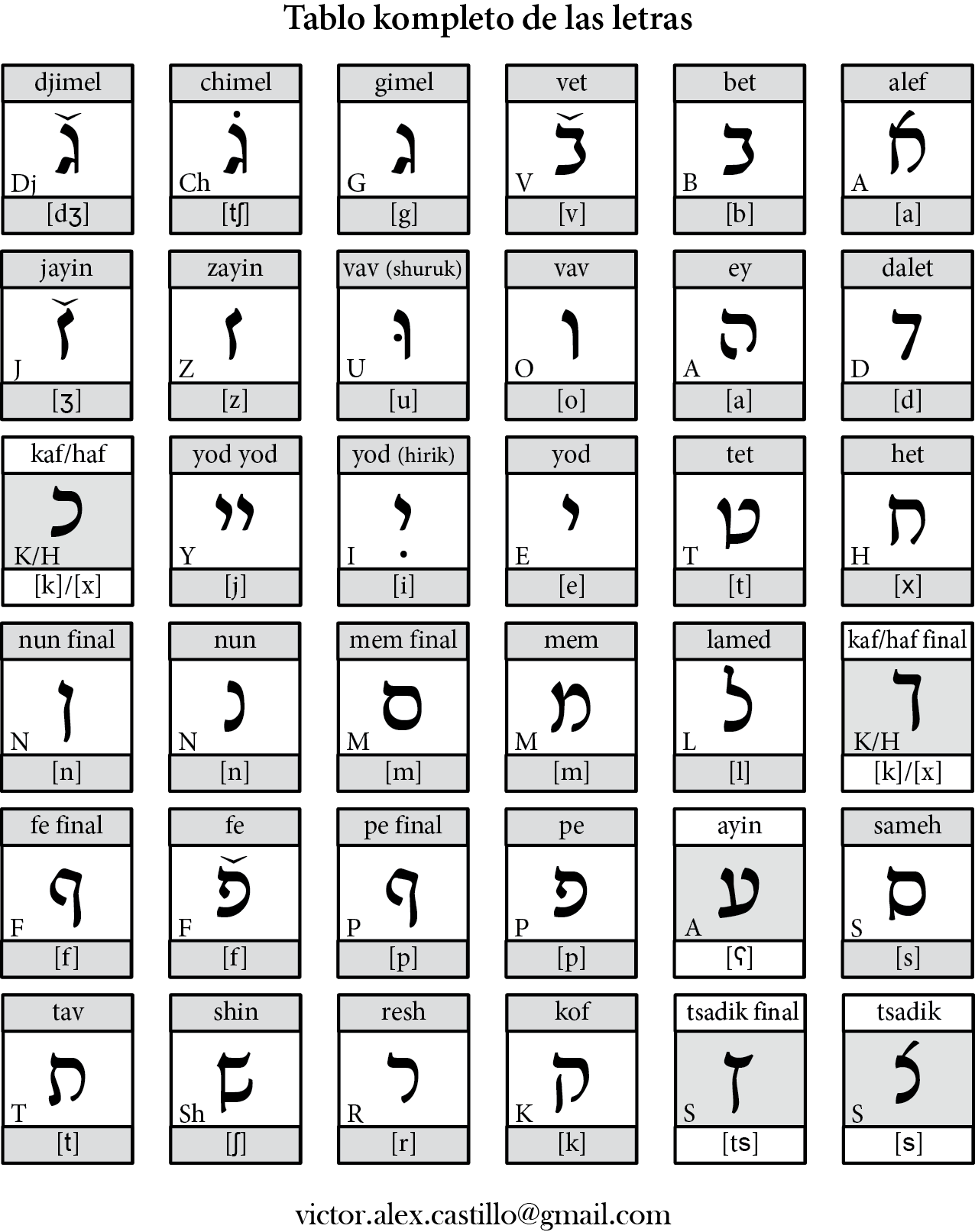
Table of characters, diacritics, and pronunciations compiled for this book, prepared by the author.